








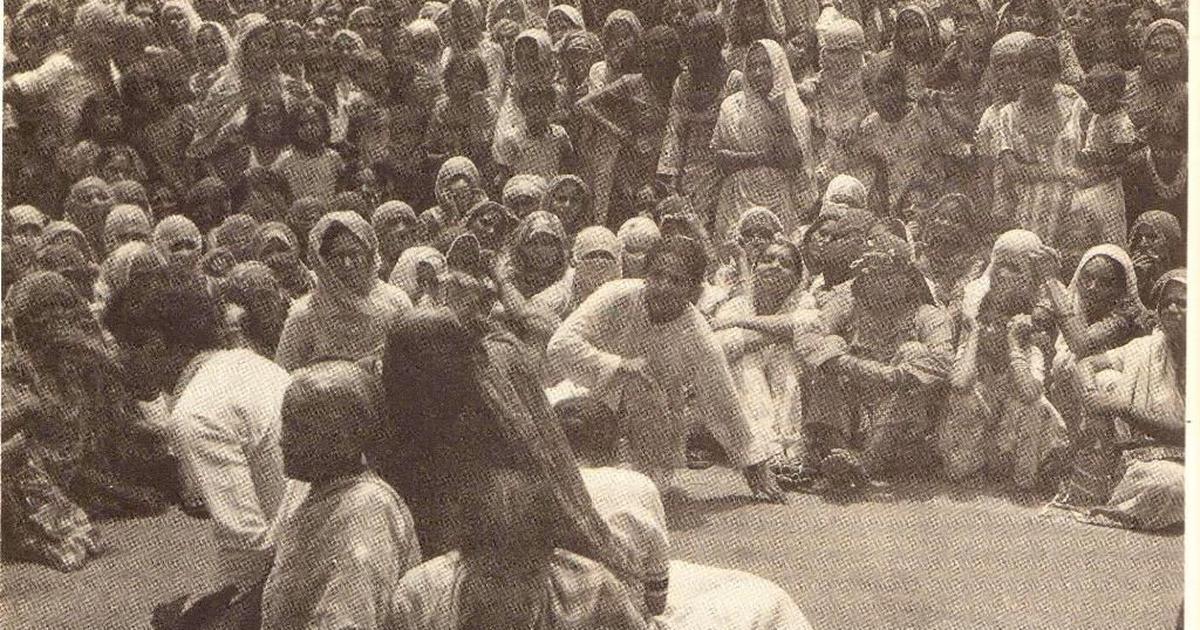
Each performance of Om Swaha, one of India’s first feminist street plays staged in 1979, was different. At the busy Patel Chowk roundabout in central Delhi, a number of men, mostly government employees, saw the play. Afterwards they dispersed, without much discussion, sharing of thoughts or experiences. At another show, performed at a workers’ meeting in Hissar, Haryana, the male audience was very responsive. The workers, and sympathisers such as Dilip Simeon, had invited the group to perform. There was a huge shamiana that housed a large gathering. The actors travelled there in a bus, and performed the play. Afterwards, the workers talked a lot, said that protests should be built up around dowry and domestic violence, and that such plays should be performed.
The play was performed in Mehrauli for farm workers, quarry workers, and their families. It fitted in well with the Mazdoor Mela organised by the Dilli Dehat Mazdoor Sangh, an independent union with which Primila Lewis, Renuka Mishra, Manmohan Dayal and Gita Sahgal were deeply involved. Action India put up an exhibition at the Mazdoor Mela called Aurat ka Chamatkar, on women’s health and reproductive rights. With almost all union members being men, there was a need to raise questions about women’s rights. Workers and their families were very interested, in the play as well as the exhibition. Theatre Union members Vinod Dua and Manohar Khushalani also acted in this show, as did a few college students.
When the play was performed in residential colonies, there was usually an immediate connection and empathy. Many people reacted as if the play was presenting their reality, reflecting it back at them. At a south Delhi performance, parents of various girls began relating their stories. In Mukherjee Nagar, north Delhi, residents started talking about what was going on in their homes and in the neighbourhood. In Sujan Singh Park, an upscale neighbourhood in central Delhi, very few residents came out, but bystanders (mostly domestic help, drivers and guards) stopped to see the play, and began sharing some of their problems.
Renuka Mishra realised that the play filled a critical gap: “Strangers would begin talking to us, opening up issues they never spoke about to anyone else. I think there was no feeling of community in the city, and people missed it. We filled that vacuum without consciously intending to. We provided people with a sense of community.”
Gouri recalls being overwhelmed by the response to Om Swaha: “We’d do a show, and people would relate personal stories to us, about how their daughter was suffering, or a relative or neighbour, and appeal for help. They needed help and support.”
In the initial years, the group distributed a leaflet during their play, which had several phone numbers on it. They began receiving many distress calls, people in various crises needing urgent intervention. This was much more than the group had expected; there was no way they could cope.
Stree Sangharsh was a motley group, not in favour of institutionalising. For a few years, they had done many things together, and made a success of it: protesting “dowry deaths” and rape, picketing police stations, bringing out newsletters and leaflets, putting up poster exhibitions, and performing Om Swaha. As Subhadra Butalia muses, “Despite the fact that we argued and fought internally, for quite a while we held together and as a group we worked on different issues with an enthusiasm and commitment which would be rare to find today.” But by 1982–83, Stree Sangharsh was fading out.
Two organisations, Karmika and Saheli, developed organically from the Stree Sangharsh and Om Swaha experience. Subhadra Butalia founded Karmika, which dealt with dowry and bride-burning cases; she ran it for the next two to three decades. Saheli was collectively established, with Gouri Choudhury, Bharati Roy Chowdhury, Amrita Chhachhi, Lakshmi Rameshwar Rao, Amiya Rao, Sheba Chhacchi, Sharda behn, Runu Chakraborty, Kalpana Mehta and Rukmini Rao among the co-founders. They were soon joined by Prabeen Grewal, Vidya Rao, Savita Sharma, Ashima, Davinder, Shonu and several others who volunteered their time to carry on Saheli’s work.
These zealous activists retrieved dowries, rescued battered daughters-in-law, gheraoed (surrounded) police stations, and urged social boycotts. Amrita recalls: “We began Saheli and did what had to be done: counselling, legal aid, demonstrations. We took direct action, went ourselves to retrieve dowry. There’s conservatism now, or cautiousness, people are shocked when they hear what all we did. We put everything at risk, heart and soul.” Rukmini Rao recalls physically rescuing a woman who was locked up in her parental home. Another time, they helped a young mother by bringing her baby out of her abusive in-laws’ home. There was a stream, or torrent, of real-life situations, ‘cases’, which they handled strategically. Some of this direct action may seem naive today or impossible. But its impact was enormous, and its energy helped shake up the status quo.
As for Om Swaha, by late 1980 or early 1981, most of the original performers had left, moving on to other pressing commitments. Amrita, who had enrolled for a PhD in Sociology, went to Bombay for research, where she got further involved with trade union work and a socialist feminist group which was setting up a women’s centre. She muses: “Our activism was part of the radical spirit of the time. We broke a lot of rules, crossed many barriers, political and personal. My parents were upset. My father kept trying to bring me back home; my mother didn’t speak to me.”
Others too were handling cutting-edge work alongside personal challenges: negotiating with families, recalibrating relationships, speaking out. Women activists were always doing too much, because too much needed to be done.
Om Swaha survived, with a bunch of new actors joining in, and some of the older ones sustaining their involvement.
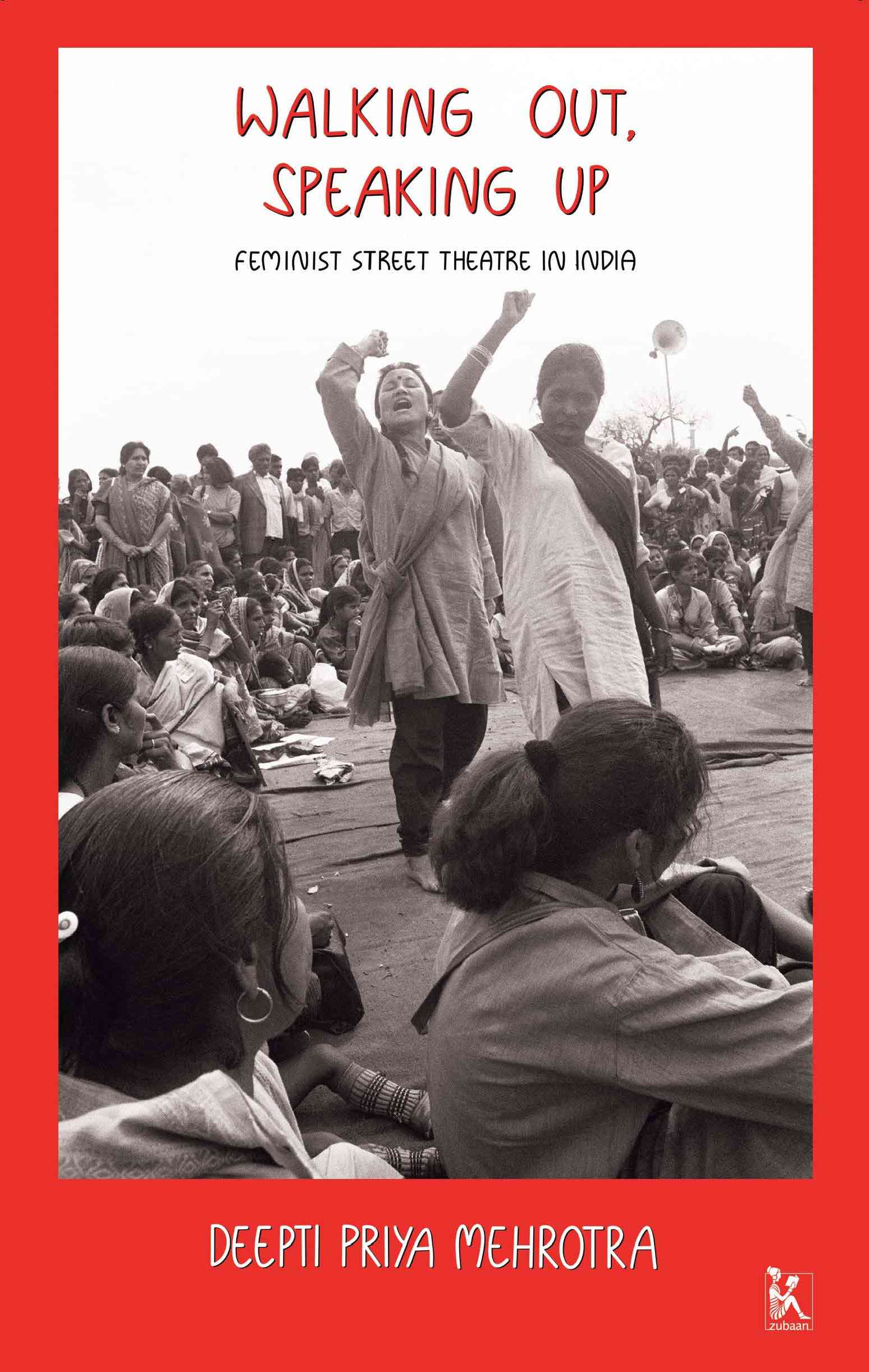
Excerpted with permission from Walking Out, Speaking Up: Feminist Street Theatre in India, by Deepti Priya Mehrotra, Zubaan.
